Changyong Song | Ph.D. Candidate @ Vanderbilt | Physics-based Animation, Simulation, AI
Hello, I’m Changyong Song — or just CHAYO, if you prefer.
I dream of exploring and designing diverse virtual worlds that feel as expressive and dynamic as the real one.
Currently, my research spans visual perception, physics-based animation, and AI-driven simulation, with a focus on bridging low-level physical dynamics and high-level perceptual understanding. I work across multiple modalities—including video, simulation outputs, and temporal signals—to build intelligent systems that not only analyze motion, but also generate physically plausible, perceptually meaningful experiences.
chang-yong.song@vanderbilt.edu
Education :
•
Thesis: MPM-Based Angular Animation of Particles using Polar Decomposition Theory
•
Grade Scholarship: 6, 7th semester
갤러리 보기
Search


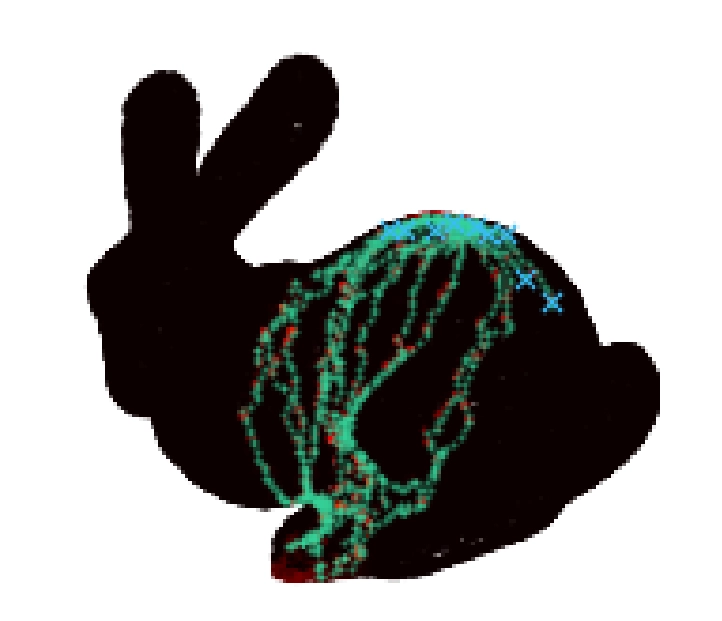
Crack Nucleation & Propagation
•
Two-field H design: We separate the strain energy history into two independent fields:
◦
H_history (tight spherical seed) — feeds the AT2 phase-field PDE solver for localized damage
◦
H_gradient (vertical gradient: strong at bottom, zero at mid-height) — provides a smooth ∇H for crack tip direction, ensuring consistent bottom→top propagation
•
Radial surface paths: At impact, 6 crack paths are seeded radially outward from the contact center (star pattern), with a low Z-component (z = 0.15) to keep paths near the bottom surface for immediate visibility
•
AT2 phase-field PDE: Variational damage model solved via Jacobi iteration. H_crack (5× H_ref) is seeded along existing crack paths as a boundary condition
Phase Field/Manifold-based Gaussian Splats Crack Simulation

Core Claim
Directly optimizing Chamfer Distance (CD) can produce worse CD values than not optimizing it at all. This is not a metric design problem — it is a gradient-structural failure.
Why It Fails (3 Propositions)
•
Prop 1. The unique attractor of the forward CD gradient is many-to-one collapse — multiple source points converge to the same target point
•
Prop 2. The reverse (t→s) term provides nonzero gradient to at most 1 of k collapsed points → the remaining k−1 are stuck in a zero-gradient deadlock
•
Prop 3. Local regularizers (repulsion, smoothness, DCD) cannot alter cluster-level drift — translational invariance guarantees pairwise forces cancel at the centroid
On the Structural Failure of Chamfer Distance in 3D Shape Optimization

1. Background & Motivation (Why?)
Commanding a robot to "cut the apple in half" is deceptively difficult.
•
Physical Complexity: Food deforms, fractures, and changes shape under pressure. Standard datasets for rigid bodies cannot capture these dynamics.
•
Data Scarcity: Collecting real-world data (e.g., slicing thousands of fruits) is expensive and dangerous. Previous simulations lacked physical accuracy regarding forces and friction.
•
Quantitative Grounding: Few existing models can understand and execute precise numerical instructions, such as "cut at the 30% mark from the right."
2. Key Solution: CulinaryCut & VLAP (How?)
CulinaryCut-VLAP: A Vision-Language-Action-Physics Framework for Food Cutting via a Force-Aware Material Point Method

TL;DR
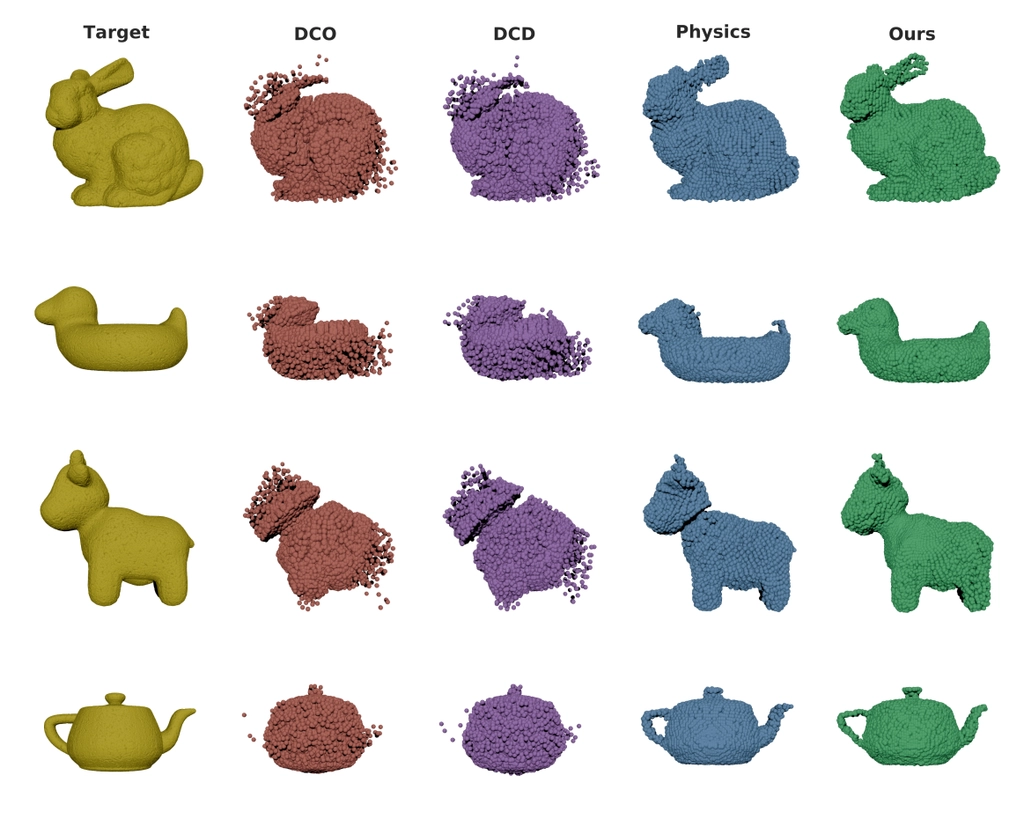
A framework combining differentiable physics simulation and 3D Gaussian Splatting (3DGS) to achieve physically plausible and visually detailed 3D volumetric shape morphing.
Key Methodology
Resolves the instability and lack of geometric detail found in prior methods via F-space injection.
•
MPM-Gaussian Mapping: Syncs the MPM deformation gradient $\mathbf{F}$ with the Gaussian covariance Σ(Σ=FΣ0F⊤).

•
Control-Space (F) Injection: Injects rendering errors exclusively into the deformation gradient (F), avoiding the simulation crashes caused by modifying particle positions (x).
PhysMorph-GS: Render-Guided Volumetric Morphing with Differentiable Physics
TVCG Teaser Video:
Rendering results:
•
Sphere to Bunny & Duck to Cow:
•
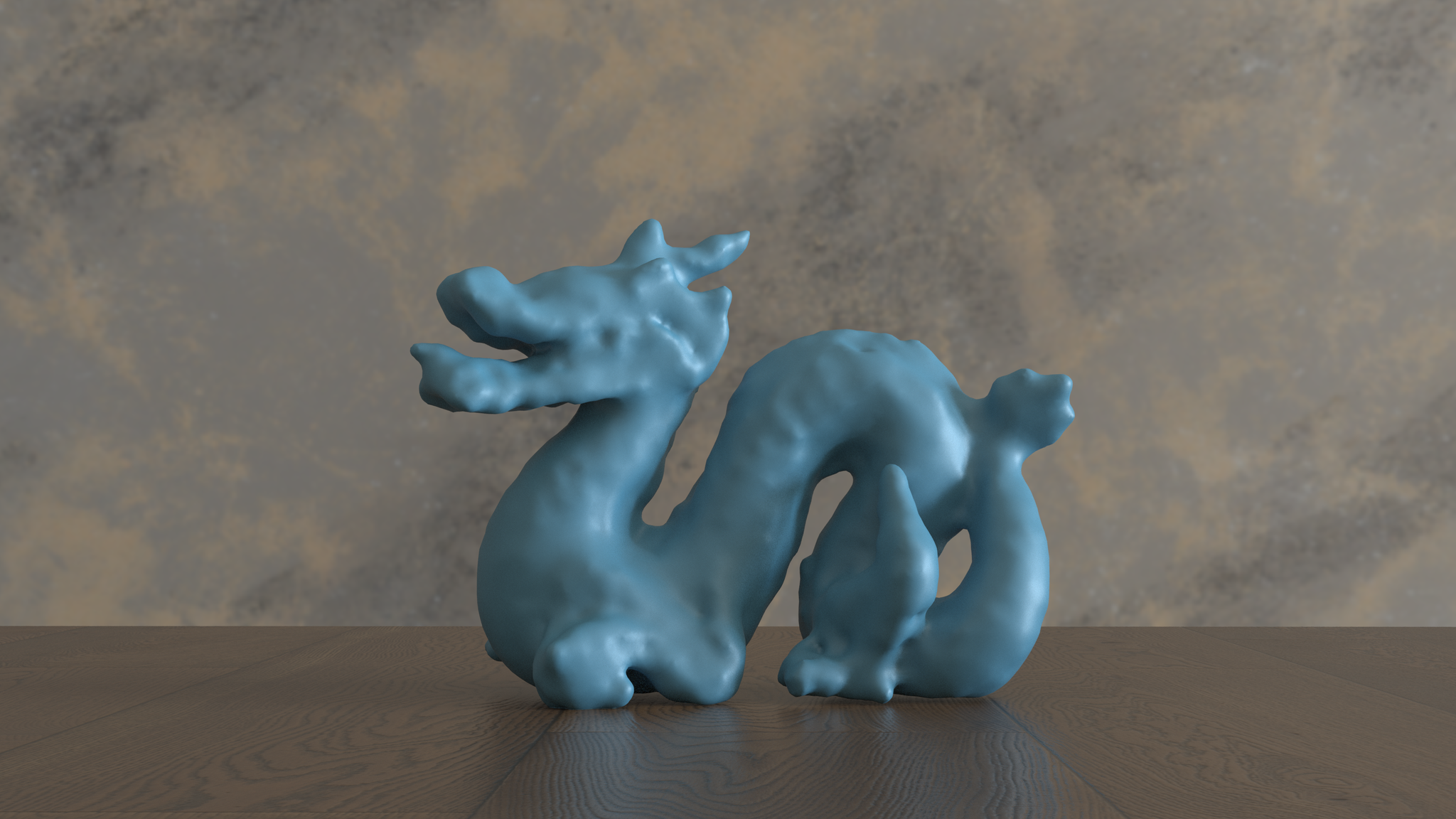
D to Dragon:
A Differentiable Material Point Method Framework for Shape Morphing
•
Abstract :
◦
In this paper, we propose a novel approach to simultaneously express the angular and linear motion of the particle itself. During the integration process of the presented MPM (Material Point Method), a deformation gradient tensor is decomposed by polar decomposition theory to extract the rotation tensor. By applying this together with the linear motion of each particle, we can possibly depict each particle’s spin.
Rendering results:
•
Sand particle example:

•
Snow with Car:

•
Primitive Rectangle (vs MPM):
MPM-Based Angular Animation of Particles using Polar Decomposition Theory
Describe Lava’s localization with wax

•
Use Numeric Animation for Real Data in Gen AI
◦
◦
◦
◦
◦
◦
◦
Lava Simulation based on Wax
갤러리 보기
Search

CLO Virtual Fashion, LLC @ NYC

•
Develop and implement large-scale Gaussian splatting scene reconstruction processes to enhance visual accuracy.
•
Integrate physics simulation layers, including fire modeling and earthquake effects, to create realistic disaster scenarios.
•
Contribute to the advancement of technology linking digital twins with LLM-based disaster scenario generators, improving response strategies.
Percept @ Berkeley
갤러리 보기
Search
•
Abstract:
◦
We propose a lightweight neural network classifier that detects unstable frames in physics-based animation (MPM) simulations. To ensure the reliability of predictions under pixel-level perturbations, we apply formal verification using the nnenum tool. Our model is trained on a custom dataset of successful and failed simulations generated by a differentiable MPM-based morphing framework. We also apply adversarial training methods (FGSM, PGD) and evaluate certified robustness using CROWN-IBP.
◦
◦
Results

◦
▪
PGD-trained model achieved 99.88% test accuracy
▪
Regular & FGSM-trained models: 99.25%
◦
▪
No models passed global verification at even small perturbation (ϵ = 0.02)
▪
PGD-trained model showed localized certifiable robustness on high-confidence samples (up to ϵ = 0.07)
◦
▪
CNN2 achieved state-of-the-art performance with <1M parameters, making it verifiable and efficient
◦
▪
3694 stable frames / 2308 unstable frames
▪
Generated from custom differentiable MPM morphing simulations
Automated Verification of Neural Network-Based Image Classifier for Stability Assurance in Graphics Rendering
Abstract:
•
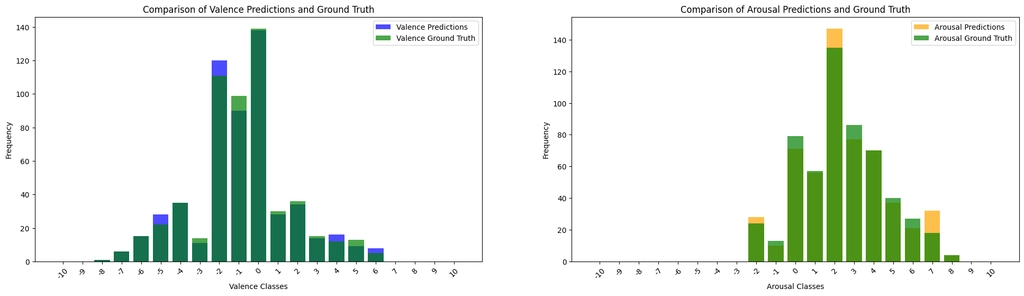
We introduce a hybrid emotion recognition model that combines a pre-trained EfficientNet backbone with LSTM to capture the temporal dynamics of facial expressions. Unlike traditional static FER approaches, our model processes video sequences to classify valence and arousal into 21-level categories (from -10 to 10), enabling more accurate emotion estimation over time. The system is trained on the AFEW-VA dataset and outperforms baseline CNN-LSTM architectures, demonstrating the benefits of integrating spatio-temporal modeling in affective computing.
◦
Paper:
Sequence-based FER using EfficientNet and LSTM.pdf
324.4KB
Results

Metric | Valence | Arousal |
F1 Score | 0.8938 | 0.8223 |
Accuracy | 0.9222 | 0.8517 |
CCC | 0.9738 | 0.9613 |
•
Sequence-Based Facial Emotion Recognition using EfficientNet and LSTM
Compressible Flow Simulation using FEniCS
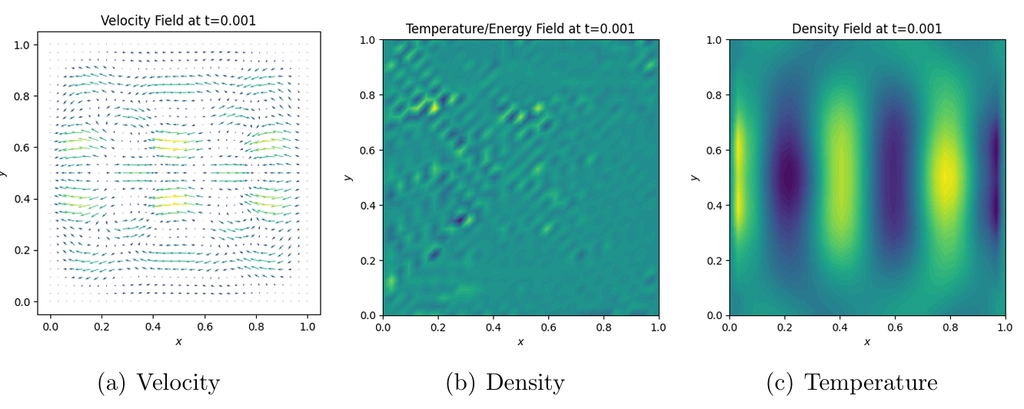
I implemented a simulation of compressible fluid flow using the finite element framework FEniCS. The governing equations include the full Navier–Stokes equations, accounting for variable density, momentum conservation, and thermal energy transport:

•
Mass conservation: ∂ρ/∂t + ∇·(ρu) = 0
•
Momentum equation includes both viscous and pressure forces with variable density
•
Energy conservation: accounts for heat convection and conduction
I derived and implemented the weak forms of these equations to suit finite element analysis.
During simulation, we encountered numerical instability, particularly in the advection term. To address this, we plan to incorporate SUPG (Streamline Upwind Petrov-Galerkin) stabilization, which mitigates oscillations and enhances robustness in advection-dominated flows.
Compressible Flow Implementation with FeniCS
•
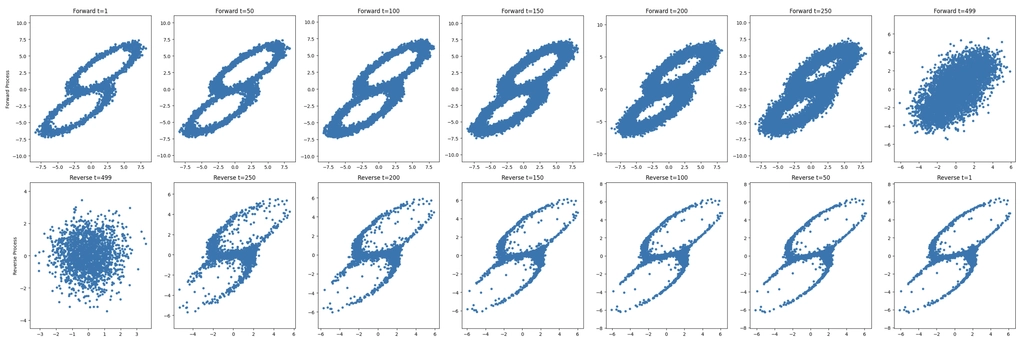
Diffusion Model

•
GAN


•
Regression
Machine Learning Algorithms Implementation
Texture Volume Rendering with GLSL


•
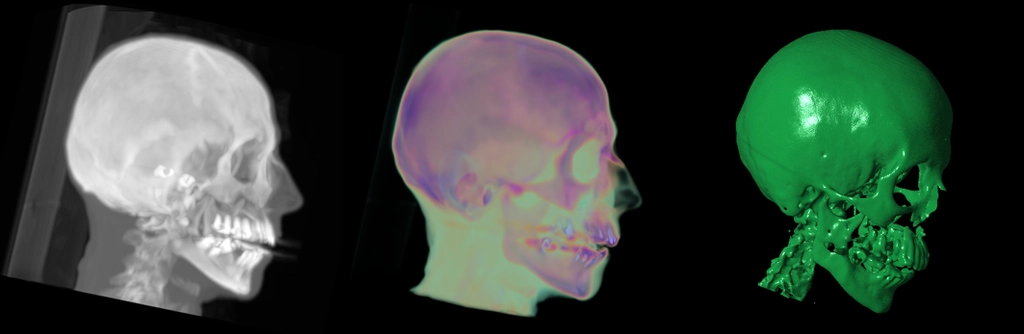
This project implements GPU-based volume rendering using GLSL. Rays are cast through a 3D texture volume, with AABB (Axis-Aligned Bounding Box) intersection used to compute entry and exit points for ray traversal. The renderer supports alpha blending for accumulating semi-transparent voxel colors and isocontouring for visualizing surfaces of constant intensity. The combined use of ray marching and transfer functions allows for flexible and efficient real-time rendering of volumetric datasets.
Volume Rendering using GLSL
갤러리 보기
Search
Implemented various real-time physics simulations using OpenGL and Unity 3D , focusing on deformable bodies and cloth-like behavior using the Mass-Spring System.
•
•
•
Implemented a dynamic spring-mass network to simulate elastic behavior
Physics Simulation using Mass-Spring System & Deformation

•
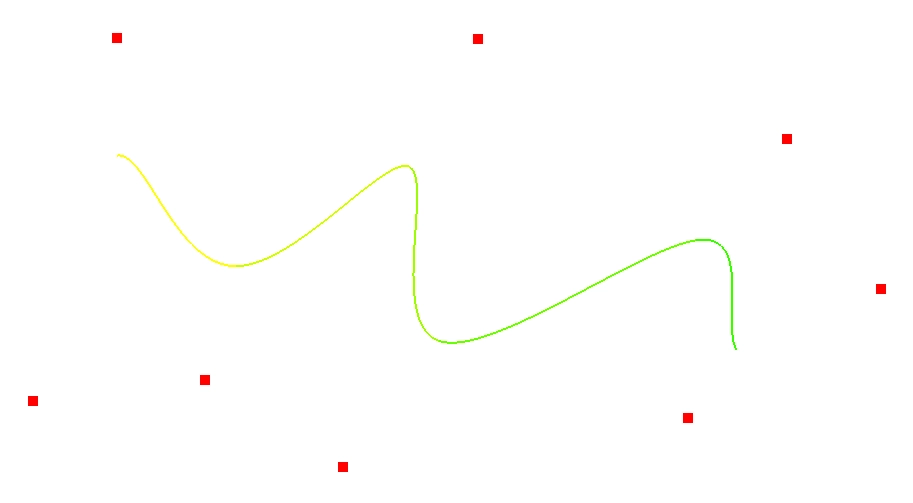
Implemented natural cubic spline and B-spline curve algorithms from scratch for smooth curve interpolation and modeling.
•
Developed an interactive system for curve construction, supporting user-defined control points and real-time visualization.
•
Explored properties of different spline types such as continuity (C¹, C²), local control, and smoothness.
•
Compared spline types through visual and mathematical analysis to understand their behavior and suitability in animation or modeling tasks.
Results:
Curve Implementation
•
Developed multiple graphics demos using OpenGL, demonstrating object transformation, lighting, and rendering techniques with various mathematical frameworks.
•
Displayed animated object movement and lighting using OpenGL shaders
•
Built a basic ray tracer visualizing geometric object intersections and illumination
OpenGL
Designed and implemented core gameplay elements in Unity 3D, including character motion, particle effects, and enemy AI behaviors.
•
Created animation controllers for player movement, attack sequences, and skill execution.
•
Designed real-time visual effects using Unity's VFX graph and particle system to enhance gameplay feedback.
•
Developed enemy AI logic with state transitions (Idle, Chase, Attack) and boss fight mechanics
Unity 3D Game Development: Motion & Particle FX Design
Designed a fully immersive VR gameplay experience using Unreal Engine 4, focusing on monster pattern design, level/map layout, and player-environment interaction in a virtual space.
•
Developed AI behavior and attack patterns tailored for VR combat experience.
•
Created a spatially optimized environment for VR movement and interaction, balancing line-of-sight, cover, and action zones.
•
Implemented intuitive player interaction using motion controllers and head tracking
VR Game Design using Unreal Engine 4
Clear all dots within the time limit by strategically connecting same-colored dots.
•
Developed a real-time puzzle game inspired by Two Dots, where the objective is to reduce all remaining dots to zero.
•
Implemented core gameplay mechanics: dot matching, chain elimination, combo detection, and time-based challenge system.
•
Designed intuitive UI and grid system for visualizing dot connections using a custom rendering loop.
•
Added mission tracking, real-time countdown, and animated feedback for player actions.
Two Dots-Inspired Puzzle Game
Table
At a glance
Search
Subject Name
Duration of work
Institution
Seminars (Korean)
•
Position-Based Dynamics (21. 2)
•
Stormscapes: simulating cloud dynamics in the now (22. 5)
[220512]_PaperSeminar_.pdf
3074.1KB
•
Simulating Fracture with Material Points (22.9)
[220901]_Paper_Seminar_Simulating Brittle Fracture.pdf
2734.8KB