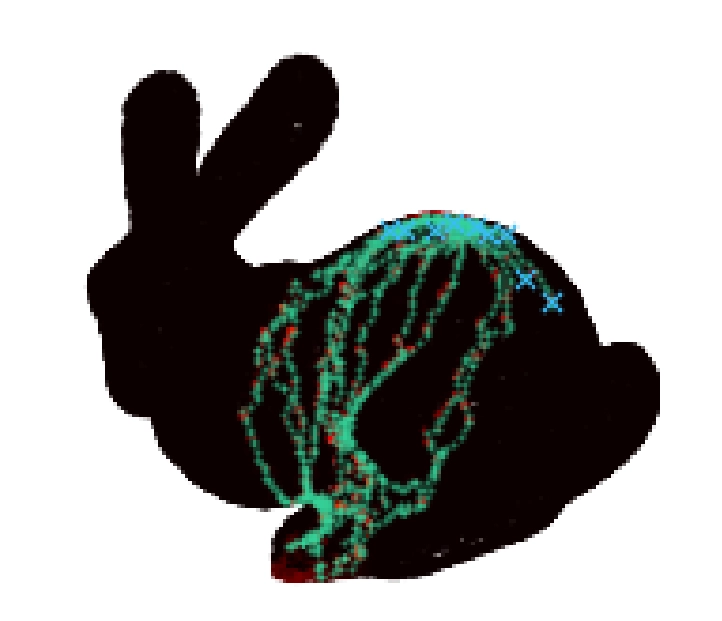
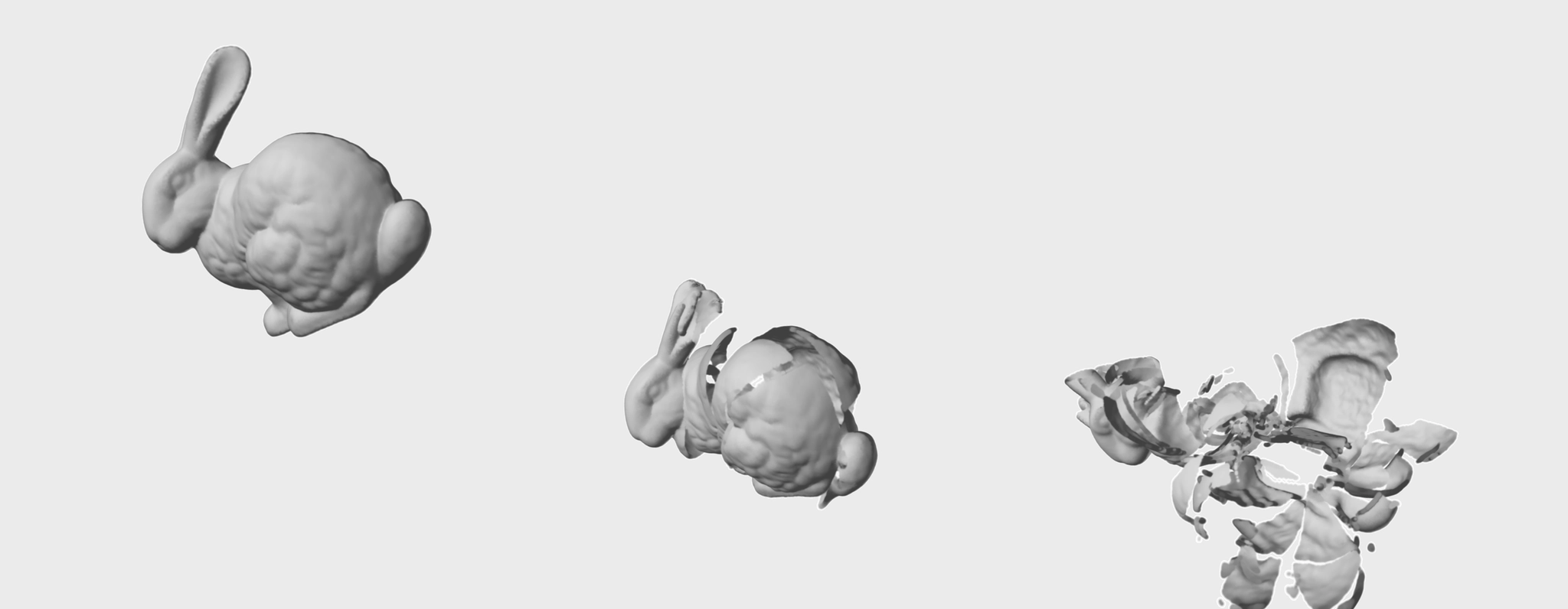
Crack Nucleation & Propagation
•
Two-field H design: We separate the strain energy history into two independent fields:
◦
H_history (tight spherical seed) — feeds the AT2 phase-field PDE solver for localized damage
◦
H_gradient (vertical gradient: strong at bottom, zero at mid-height) — provides a smooth ∇H for crack tip direction, ensuring consistent bottom→top propagation
•
Radial surface paths: At impact, 6 crack paths are seeded radially outward from the contact center (star pattern), with a low Z-component (z = 0.15) to keep paths near the bottom surface for immediate visibility
•
AT2 phase-field PDE: Variational damage model solved via Jacobi iteration. H_crack (5× H_ref) is seeded along existing crack paths as a boundary condition
•
H-gated tip advancement: Tips only advance where local H exceeds 0.1× H_ref, preventing blind extension into undamaged regions (ears, nose)
•
EMA direction smoothing (α = 0.15): Maintains radial propagation direction, gradually rotating upward following ∇H
•
Physics H suppression: MPM stress-driven H is suppressed for 20 frames post-impact, preventing stress wave artifacts at thin geometry (ears, neck). Only the impact-seeded H drives initial crack formation
Rendering
•
Gaussian Splatting with crack-aware visualization
•
Damaged Gaussians: opacity reduced to 40%, displaced up to 0.004 world units perpendicular to crack surface
•
Crack gap fraction: 0.25 for visible splitting effect
•
Crack lines rendered as thin geometric damage (width = 0.006) from polyline proximity
