
 TL;DR
TL;DR
A framework combining differentiable physics simulation and 3D Gaussian Splatting (3DGS) to achieve physically plausible and visually detailed 3D volumetric shape morphing.
Key Methodology
Resolves the instability and lack of geometric detail found in prior methods via F-space injection.
•
MPM-Gaussian Mapping: Syncs the MPM deformation gradient $\mathbf{F}$ with the Gaussian covariance .

•
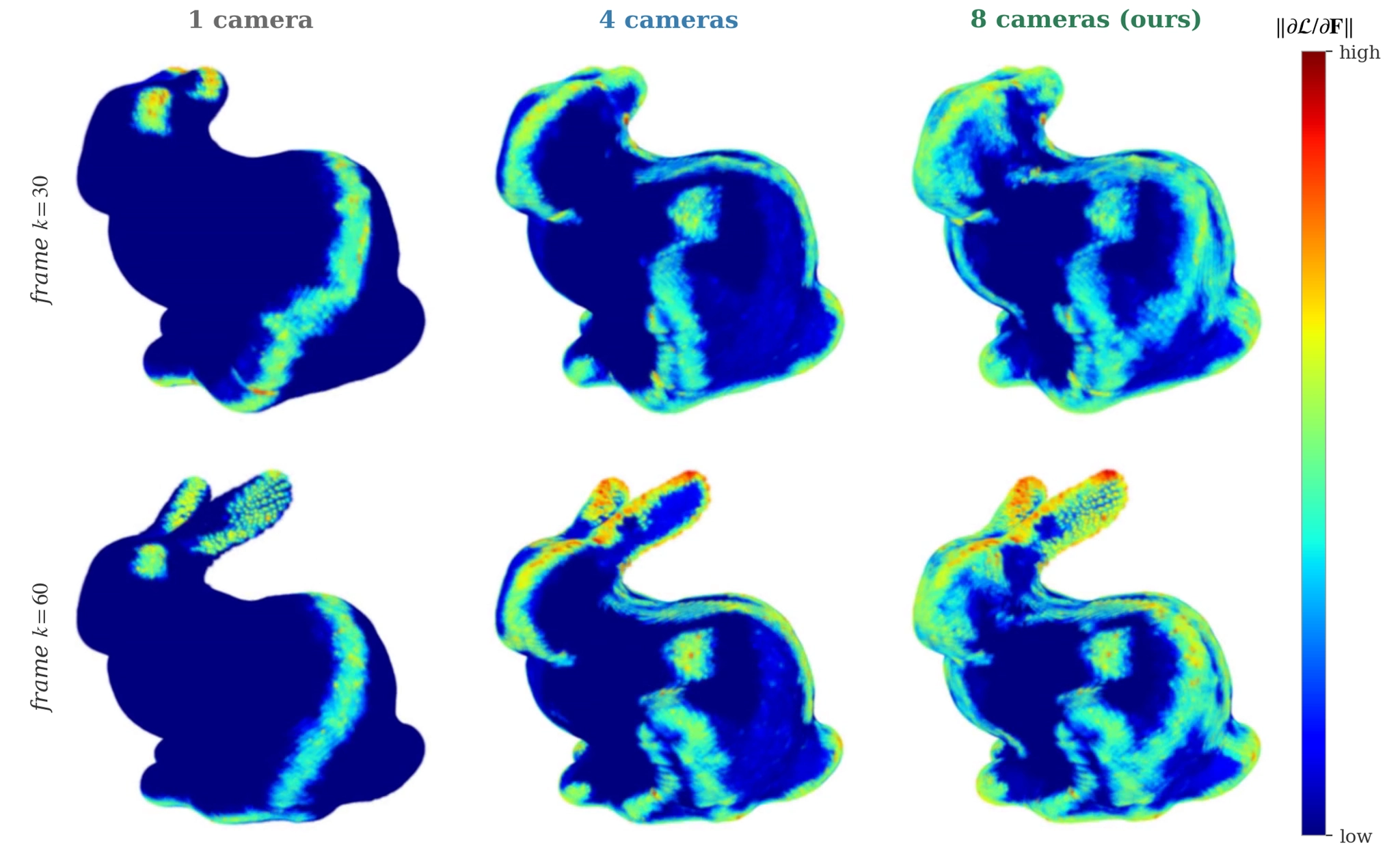
Control-Space () Injection: Injects rendering errors exclusively into the deformation gradient (), avoiding the simulation crashes caused by modifying particle positions ().
•
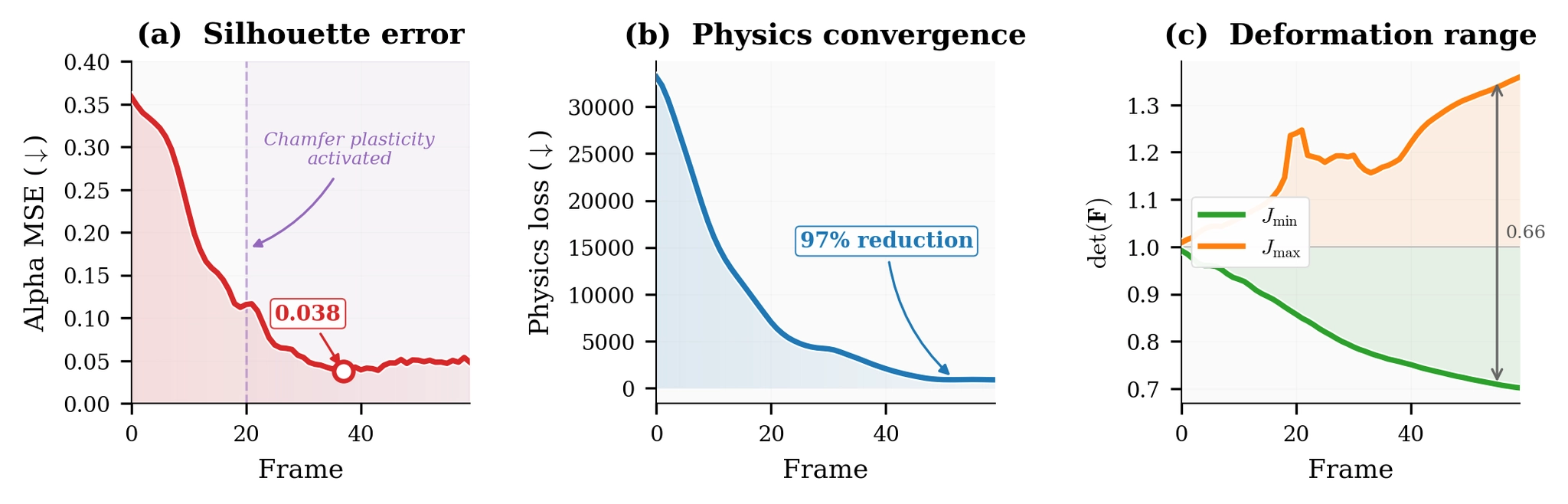
Phased Chamfer Plasticity: After an initial structural warmup (), updates plastic deformation using the target surface to redirect elastic restoring forces toward the target.
•
Surface Masking: Renders only particles near the surface to maximize computational efficiency and gradient focus.
Key Results
•
Lower Silhouette Error: Highly effective on models with thin structures. (Error reduction vs. physics-only baseline: Duck 49.9%, Bunny 25.8%, Cow 10.8%).
•
Source Invariance: Reliably converges to the same target (e.g., Bunny) regardless of the starting shape (Isosphere, Cow, or Duck) with an error variance of just 10.3%.
•
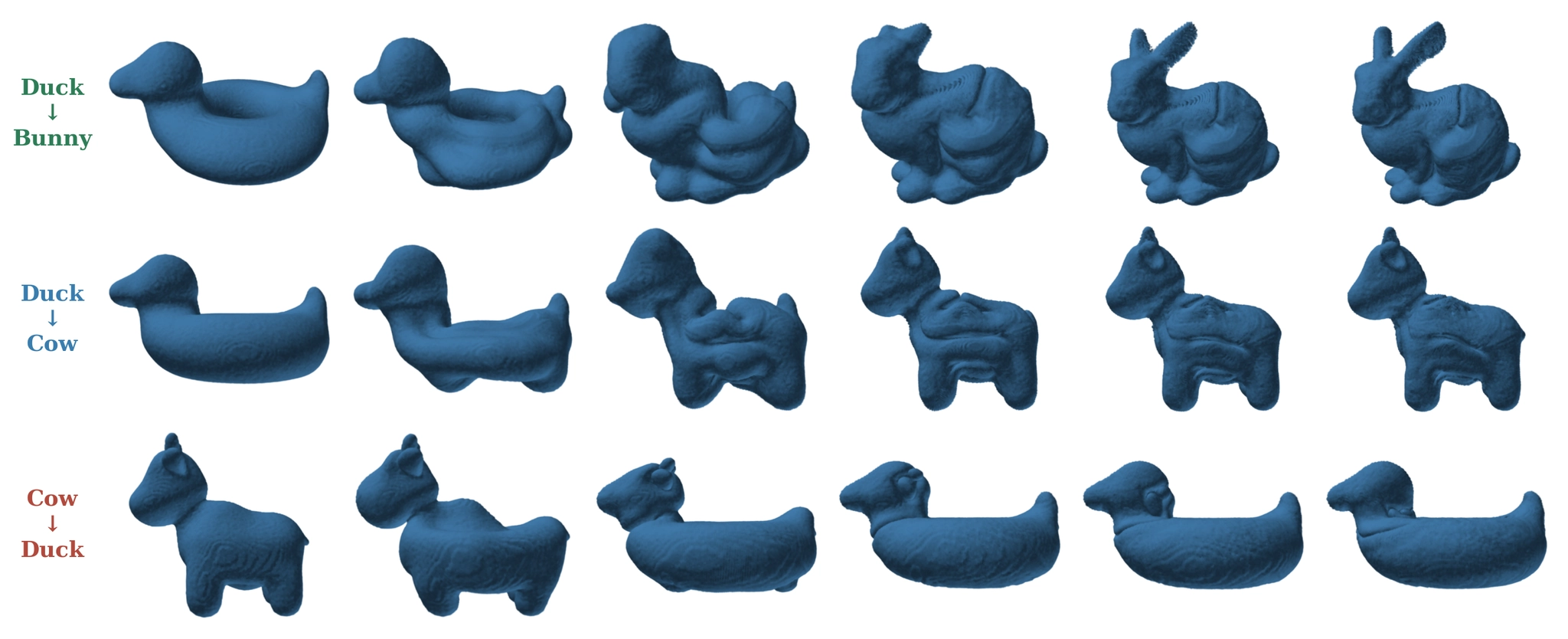
Cross-Shape Morphing: Successfully handles complex, bi-directional topology changes (e.g., Duck Cow) without requiring per-pair parameter tuning.
•
Efficiency: Completes one frame in 4 minutes for 534K particles on a single RTX GPU.
Limitations & Future Work
•
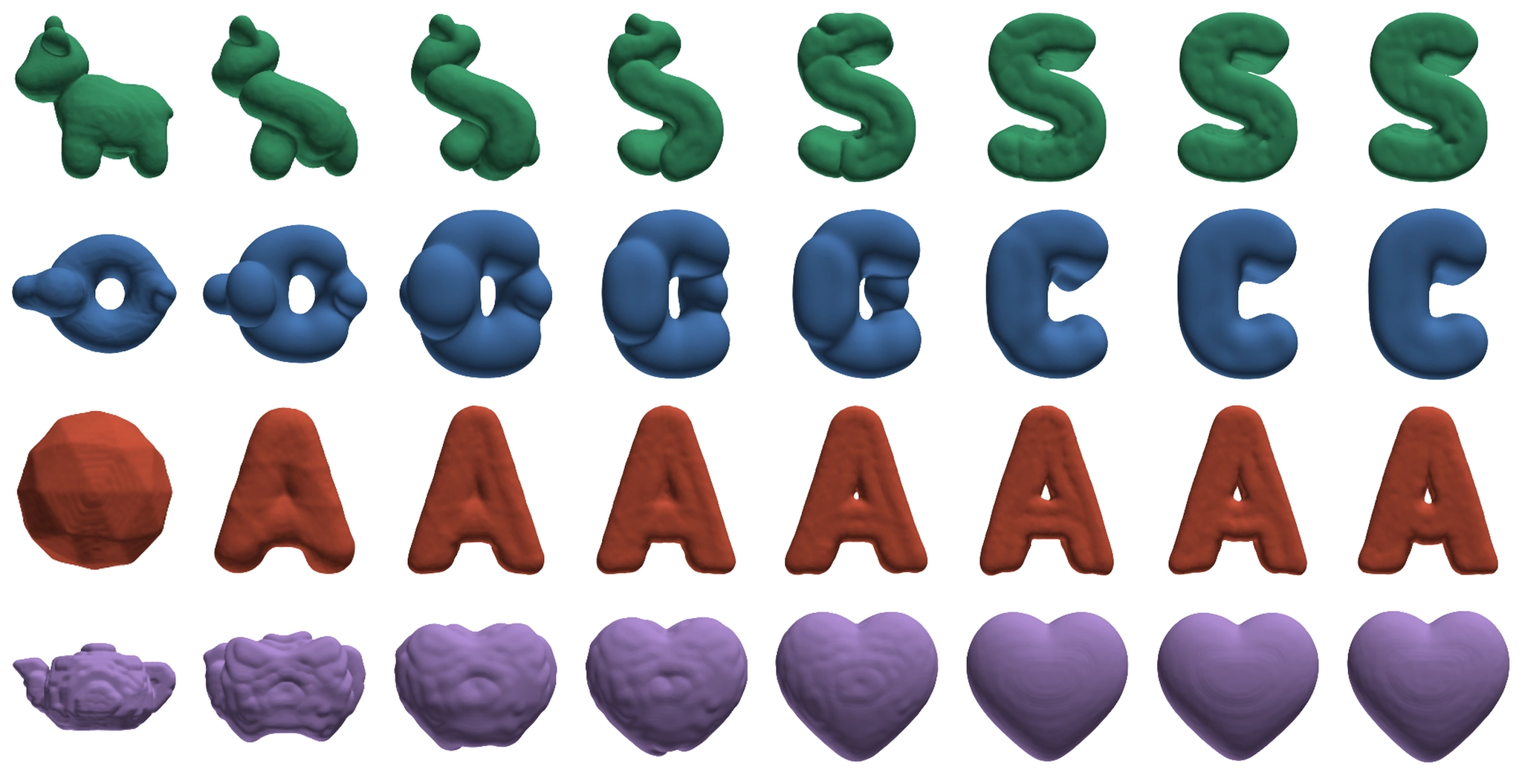
Fixed particle counts limit resolution on thin structures (requires adaptive particle redistribution).
•
Elastic forces resist the topology changes required for highly concave targets (e.g., letters with interior holes).
•
Strict volume conservation is not perfectly guaranteed during high-compression phases.
