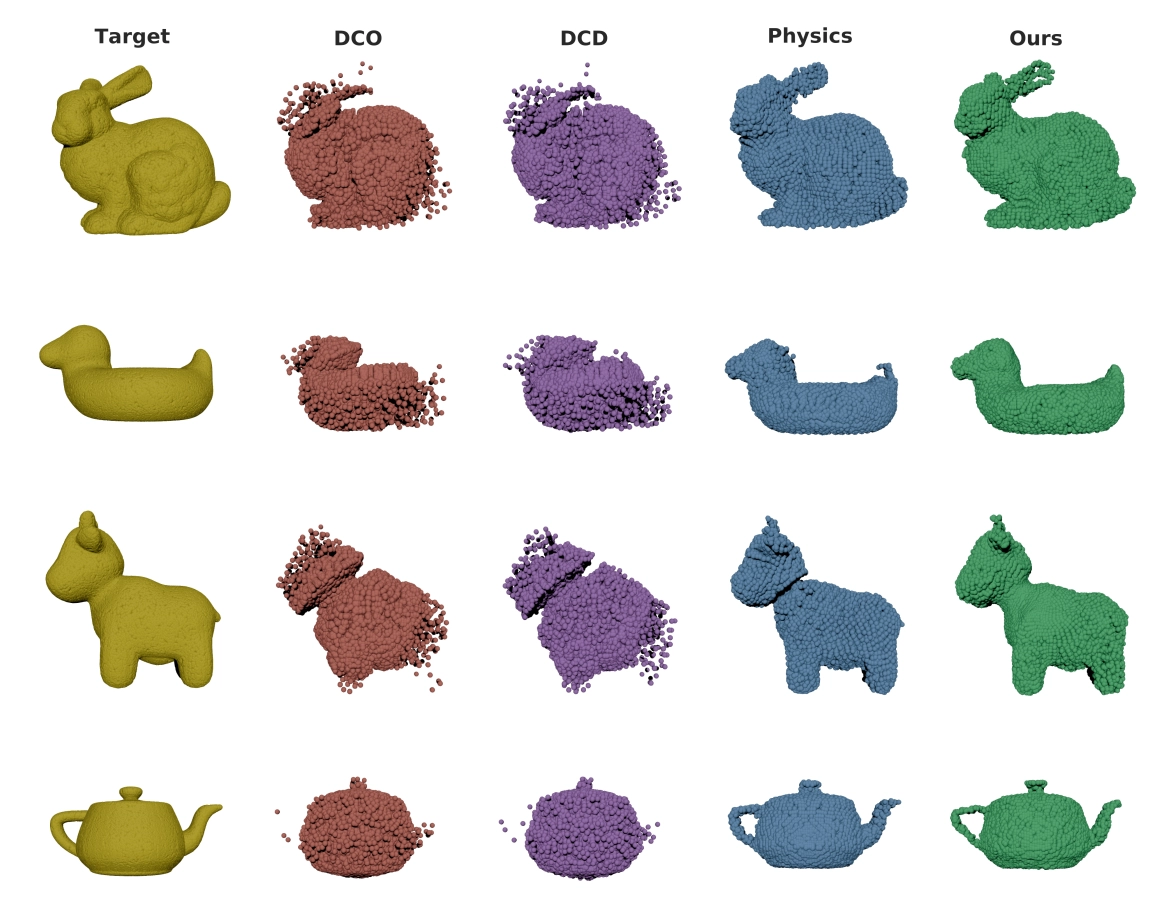
Core Claim
Directly optimizing Chamfer Distance (CD) can produce worse CD values than not optimizing it at all. This is not a metric design problem — it is a gradient-structural failure.
Why It Fails (3 Propositions)
•
Prop 1. The unique attractor of the forward CD gradient is many-to-one collapse — multiple source points converge to the same target point
•
Prop 2. The reverse (t→s) term provides nonzero gradient to at most 1 of k collapsed points → the remaining k−1 are stuck in a zero-gradient deadlock
•
Prop 3. Local regularizers (repulsion, smoothness, DCD) cannot alter cluster-level drift — translational invariance guarantees pairwise forces cancel at the centroid
The Fix (Corollary 1)
Collapse suppression requires coupling that propagates beyond local neighborhoods.
Method | Global Coupling | Result |
DCO | ✗ | collapse |
DCO + Repulsion | ✗ (local) | collapse |
DCD | ✗ (local reweighting) | collapse |
MPM prior | ✓ (shared Eulerian grid) | suppressed |
Fourier basis (2D) | ✓ (shared parameters) | suppressed |
Results
•
20 directed shape pairs: our method improves two-sided CD on 16/20
•
Dragon (topologically complex): 2.5× improvement over physics-only at 4ppc
•
Consistent gains confirmed by Hausdorff distance and F1-score
Practical Guidelines
DCO / Physics Ratio | Risk | Recommendation |
≤ 1× (nearly convex) | Low | CD alone is acceptable |
1.3–2.0× | Moderate | Global coupling recommended |
> 2× | High | CD without global coupling strongly discouraged |
One-Line Takeaway
When using CD as a training loss, the architecture must provide non-local coupling. Redesigning the metric alone cannot resolve the failure.
